

Latest Version
John W. Eaton and others
Education
Linux
Free
org.octave.Octave
Report a Problem
More About GNU Octave
The Challenge of Complex Mathematical Computations
Researchers, engineers, and data analysts often face the daunting task of solving intricate mathematical equations without the budget for expensive proprietary software. When dealing with advanced linear algebra or non-linear systems, you need a robust environment that handles heavy data visualization and numerical experiments seamlessly. This is where the GNU Octave scientific programming language steps in, offering a high-level interpreted language specifically designed to tackle these intense computational challenges on Linux systems.
How the GNU Octave Scientific Programming Language Solves Your Problems
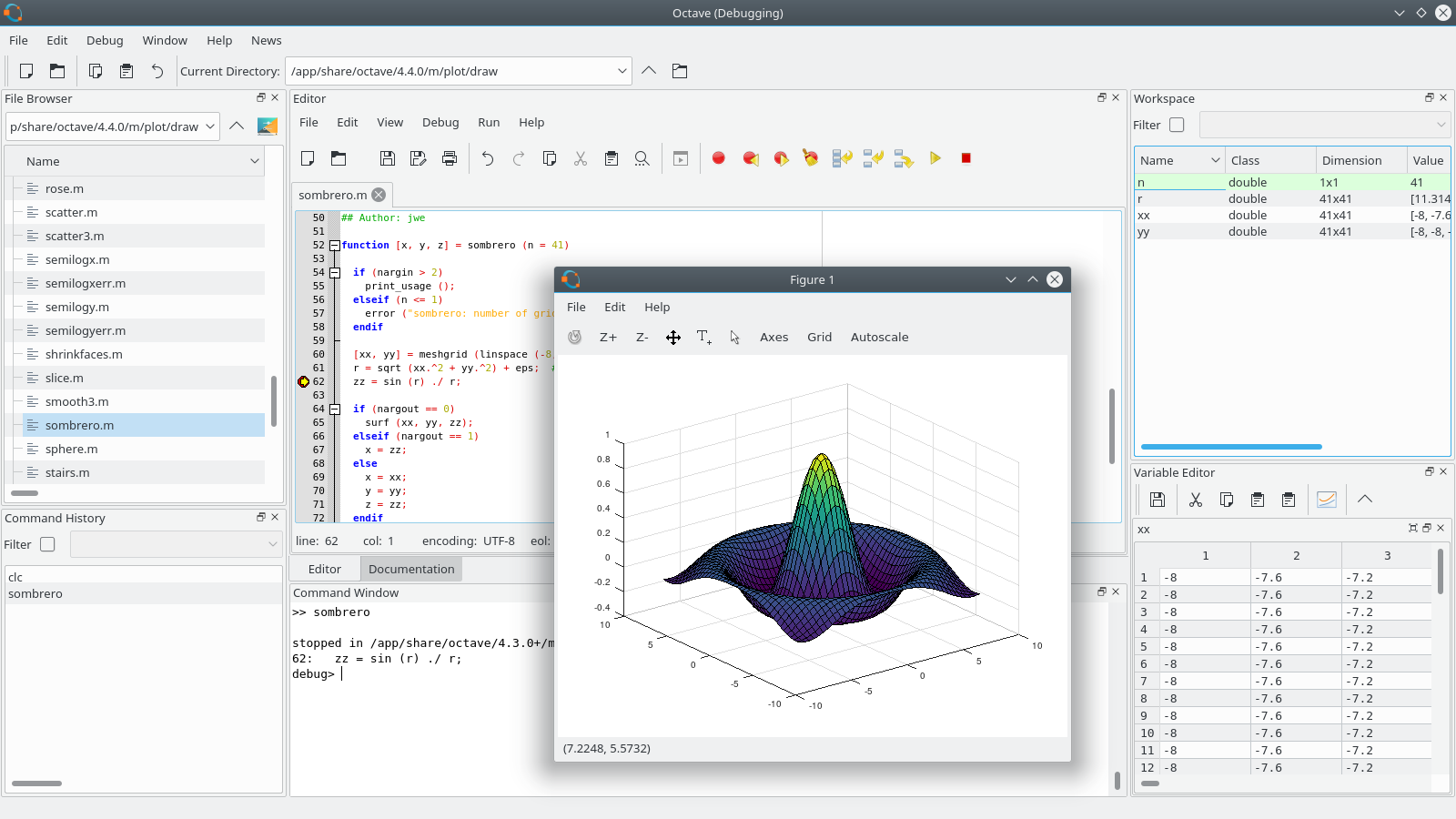
Developed by John W. Eaton and others, the GNU Octave scientific programming language provides a highly compatible, open-source alternative to mainstream mathematical computing environments. It operates primarily through an interactive command-line interface, though it is equally capable of executing non-interactive, automated scripts. Because its syntax is remarkably similar to Matlab, porting existing codebases and adapting your workflows is incredibly straightforward.
Key Features and Capabilities
- Advanced Numerical Solvers: Easily find roots of nonlinear equations, manipulate polynomials, and solve complex linear algebra problems.
- Differential Equation Integration: Built-in tools facilitate the integration of ordinary differential and differential-algebraic equations.
- Data Visualization: Utilize extensive graphical capabilities to plot, manipulate, and visualize multi-dimensional data sets.
- Extensible Architecture: Custom functions can be written in Octave's native language or integrated using dynamically loaded modules written in C++, C, or Fortran.
Who Is This Platform For?
Classified under the education and scientific categories, this tool is ideal for university students, academic researchers, and industrial engineers who require deep numerical capabilities on Linux. Whether you are teaching linear algebra or simulating physical systems, it provides the necessary computational depth without licensing friction.
Explore the Official Platform
If you are ready to elevate your data analysis and numerical modeling, we highly recommend exploring this powerful tool. To learn more or to set up the environment on your Linux system, visit the official distribution page on Flathub today.
Rate the App
User Reviews



Popular Apps










Editor's Choice